

Prepared by the Farming Homestead Online editorial team. Sources and wording last checked on 2 September 2026. Use the guide for planning, then confirm current facts for your exact site.
Short answer: Fruit trees can build valuable long-term income, but US$11,000 is not a result you can promise from a headline. It depends on how many healthy trees are producing, saleable yield per tree, grade, price actually received, water, years to production, annual costs and the buyer. Test every assumption and build bridge income while the trees develop.
A Zimbabwe farming reel asked a powerful question: how can somebody make US$11,000 from fruit trees in a backyard project?
People paid attention. More than 100 reacted. Some wanted to start. One commenter questioned the number of fruit assumed per tree. That disagreement is useful because it points to the real issue.
The headline is not the calculation.
A fruit tree is not a money machine. It is a long-term production unit that needs the right site, planting material, water, feeding, pruning, pest control, harvest labour, grading, handling and market.
When those parts work together, fruit trees can be a serious farm enterprise. When the parts are missing, the farmer can wait for years and still struggle to sell good fruit.
So can US$11,000 be possible? Maybe, in a particular project, season and market. Is it automatic? No.
Here is how to test the claim without killing the dream.
Start with the formula behind the headline
The simplest useful sales formula is:
Trees in production × realistic saleable kilograms per tree × average price actually received = gross fruit sales
Notice what is not in the formula:
- trees bought but not planted;
- trees planted but not yet producing;
- fruit damaged, dropped or rejected;
- the highest price seen on social media;
- fruit promised to relatives; or
- a price before transport, commission and packaging.
Then calculate profit:
Gross fruit sales − annual operating costs − harvest and selling costs − finance costs − replacement and repair reserve = operating profit
The first number attracts attention. The second number builds a business.
Why counting fruit per tree can fool you
A viral calculation may say one tree carries a certain number of fruit, multiply by many trees and then multiply by a good price. Each part can be optimistic.
Trees differ. Variety, rootstock, age, weather, soil, water, pruning, nutrition, pollination, disease, wind and crop load all affect performance. Even trees in the same block do not always produce the same amount.
Fruit also differs in size and grade. A tree may carry many fruit, but the customer may pay more for a narrow quality range. Small, marked, damaged or overripe fruit may go to another market at another price.
Do not build the budget around the best-looking tree. Use a range:
- weak case;
- expected case; and
- strong case.
If the project survives the weak case and becomes attractive in the expected case, the plan is stronger.
Nine things to check before buying fruit trees
1. Does the fruit suit the place?
Zimbabwe has different Natural Regions, temperatures, frost conditions, rainfall patterns, soils and water realities. A fruit doing well on one farm may struggle on another.
Check:
- altitude and temperature range;
- frost risk;
- rainfall and dry-season length;
- soil depth and drainage;
- water quality and reliable volume;
- wind exposure;
- road access; and
- distance to the likely buyer.
Do not begin with “Which fruit makes the most money?” Begin with “Which fruit can produce the required quality here?”
The Zimbabwe Natural Regions Guide is a useful first filter before choosing the enterprise.
2. Are you buying the right planting material?
Cheap trees can become an expensive delay.
Know the variety, rootstock where relevant, age, source and health. Ask whether the material is grafted, budded or seed-grown and why that method suits the crop. Check whether the variety needs a pollinator and how it should be arranged.
Ask the nursery for:
- the exact cultivar name;
- the rootstock name where used;
- propagation method;
- plant age;
- expected bearing behaviour under local conditions;
- pollination needs;
- pest and disease history;
- hardening method; and
- replacement terms for obvious nursery failure.
Visit if possible. Look for healthy roots, a sound graft union where applicable, straight growth, clean leaves and consistent labelling. A tree without a reliable identity can leave you with the wrong fruit years later.
3. Can the water system serve the trees for years?
Fruit trees are a long commitment. A water plan that works for twenty young trees may fail when the block is larger and trees have developed.
Measure the water source. Do not rely on the seller’s word or a short pump test. Understand borehole recovery, storage, pump output, power, pipe size, pressure, filtration and irrigation zones.
Plan for the hottest and driest demand period. Include water for young-tree establishment, mature production, cleaning, workers and any bridge crop.
Also plan drainage. Waterlogged roots can be as damaging as drought in poorly drained ground.
Before major spending, use the Farm Borehole Checks Guide to organise the questions for the driller, pump supplier and irrigation designer.
4. How long until useful sales?
Different fruit crops, cultivars and planting materials take different times to produce a commercial crop. Early fruit on a young tree is not the same as stable full production.
Your cash-flow plan must carry:
- site preparation;
- planting material;
- irrigation;
- tree guards, stakes or wind protection;
- fertiliser and soil improvement;
- pruning and training;
- weed, pest and disease control;
- replacement trees;
- labour; and
- security through the development years.
Write a yearly calendar, not only one final income number.
Year one may be mostly spending. Later years may bring increasing output. The project needs another way to pay its regular bills while waiting.
5. What will provide bridge income?
Bridge income is money earned by a faster activity while the fruit trees develop.
The right bridge enterprise uses the site without damaging the trees or competing badly for water, labour and nutrients. It must also have a market.
Possible routes include:
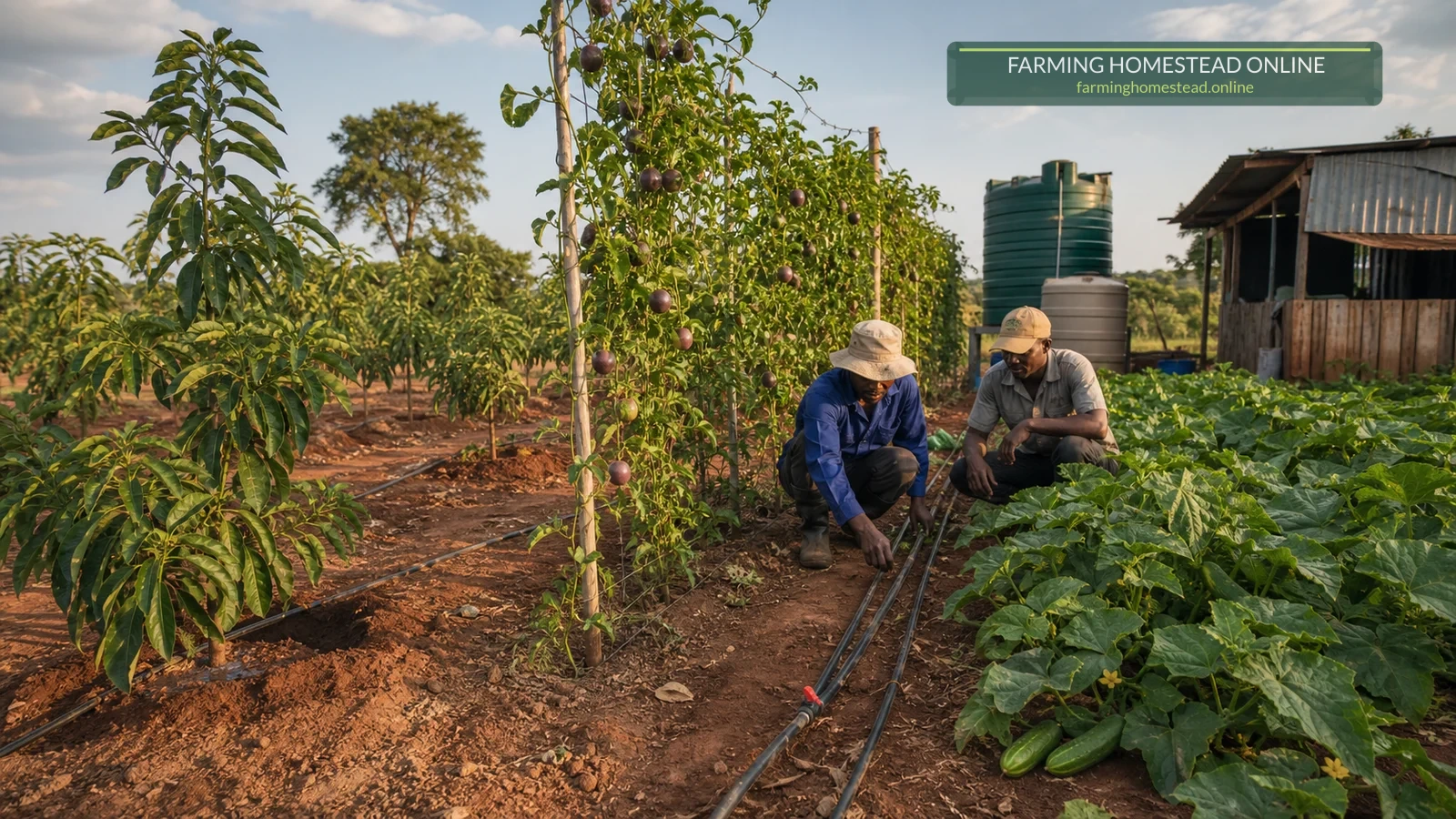
- passion fruit on planned support structures;
- cucumber or another short-cycle crop in a defined block;
- a nursery selling planting material;
- herbs or vegetables in a separate irrigated area;
- paid services using existing farm equipment; or
- carefully planned poultry or livestock away from vulnerable young trees.
Do not fill every open space simply because it is empty. Leave access for pruning, spraying, harvest, irrigation repair and future tree size.
6. Who buys each grade?
One fruit-tree block can produce several market outcomes.
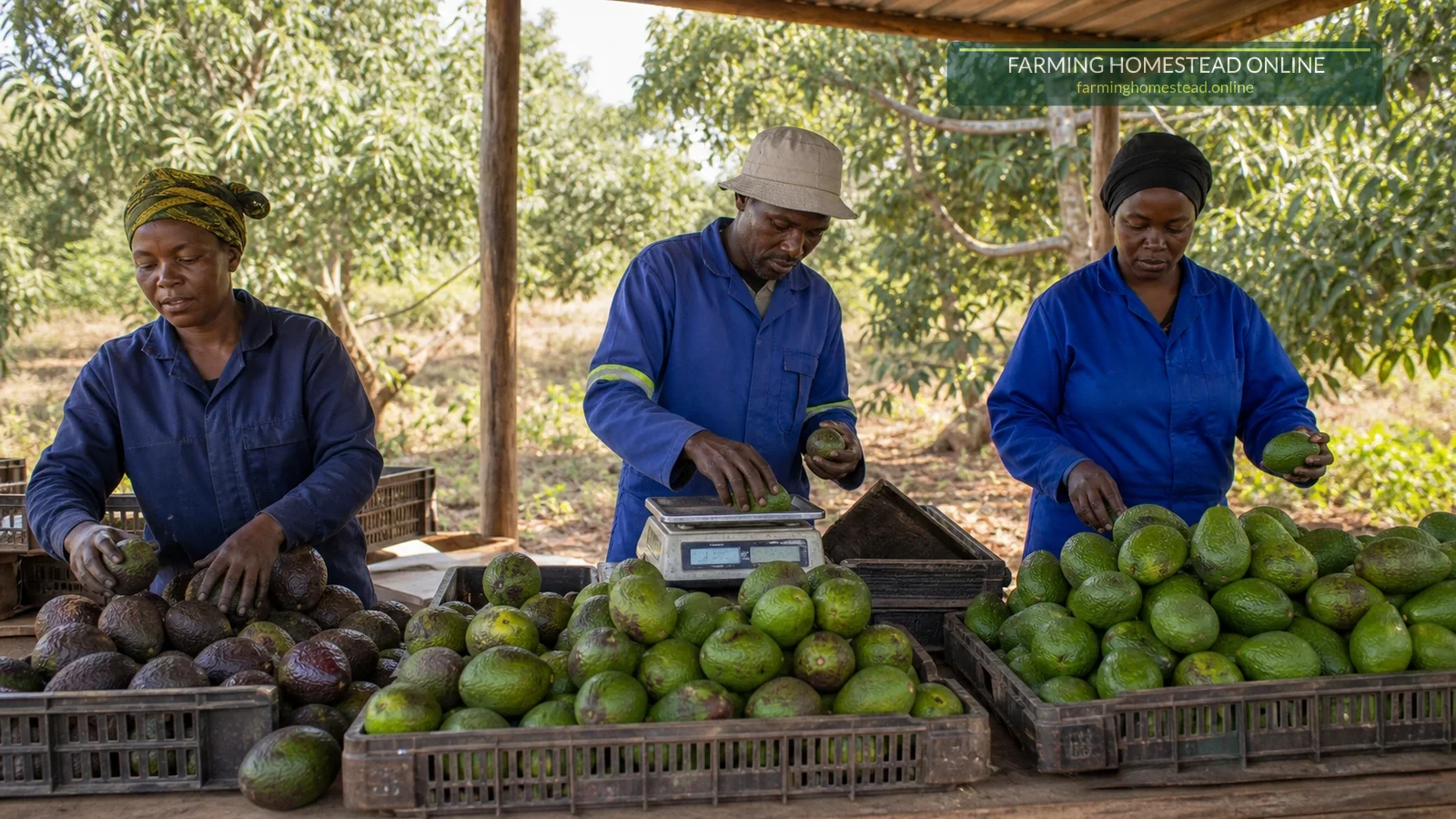
Top-grade fruit may fit a demanding retailer, packer or export-linked buyer. Sound ordinary fruit may fit wholesalers, vendors, food outlets and households. Lower grades may need a processor or value-addition route.
The Ministry of Agriculture’s crop and livestock assessment reported rising avocado production in 2023/24 while noting that only part of production was exportable. The lesson for a new grower is simple: do not multiply the entire harvest by an export price.
Ask buyers:
- preferred variety;
- acceptable size and appearance;
- maturity standard;
- packaging;
- minimum volume;
- collection or delivery terms;
- quality rejections;
- payment time; and
- months of strongest demand.
Build the budget by grade. A blended average price is more realistic than one top price for every fruit.
7. Can you harvest, grade and move the fruit quickly?
The project does not end when fruit leaves the tree.
Plan picking tools, field crates, shade, sorting, clean handling, packaging, temporary holding and transport. Train workers not to drop, overfill or leave harvested fruit in the sun.
Your access road and loading point matter. So does the travel time to the buyer.
For high-value or export-linked markets, quality systems, traceability, pest records, packhouse standards and phytosanitary requirements can be strict. ZimTrade’s 2026 market guidance stresses that access alone is not enough; suppliers must deliver consistent quality and reliability.
Start with the market standard, then design production and handling to meet it.
8. What does the project cost every year?
The planting budget is only the beginning.
Annual costs can include:
- irrigation power and repairs;
- fertiliser and soil testing;
- pruning and training;
- weed, pest and disease control;
- mowing or groundcover management;
- pollination support where needed;
- labour and supervision;
- security;
- harvest tools and crates;
- grading and packaging;
- transport and commission;
- replacement trees; and
- record keeping and compliance for formal buyers.
Add these costs by year. A large gross figure several years away must be compared with all the money spent before and during that year.
9. What is your smallest sensible first block?
Starting small can protect learning, but the block must still be commercially sensible.
It needs a complete irrigation zone, correct spacing, pollination arrangement where required, access, records and a buyer plan. Random trees scattered around the homestead are difficult to irrigate, protect, harvest and measure as a business.
A first block lets you test:
- survival rate;
- actual water demand;
- supplier quality;
- labour routine;
- local pest pressure;
- customer response; and
- the cost of producing each saleable kilogram.
Expand after the first block proves the system, not simply because more land is empty.
A better way to test the US$11,000 claim
Create a table before spending:
| Input | Weak case | Expected case | Strong case |
|---|---|---|---|
| Healthy trees in production | |||
| Saleable kg per tree | |||
| Total saleable kg | |||
| Average price received per kg | |||
| Gross sales | |||
| Annual growing cost | |||
| Harvest, packing and selling cost | |||
| Repairs, replacements and finance | |||
| Estimated operating profit |
Use kilograms and grades instead of an impressive fruit count. Use prices confirmed with likely buyers. Put the expected sales year at the top of the page.
Then ask: if the price is lower, the crop is smaller or one buyer rejects a grade, can the project continue?
That is how a headline becomes a decision.
Fruit trees can create more than one income route
Fresh fruit is only one route. Depending on scale, quality, food-safety requirements and equipment, fruit may also support drying, pulping, oil, frozen pieces or other processing.
ZimTrade has highlighted avocado value addition as a way to diversify income and reduce post-harvest loss. That does not mean every small farmer should buy processing equipment. First prove the raw material volume, product standard, buyer, food-safety system and processing cost.
Sometimes the better first partnership is supplying a capable processor rather than building a factory.
See how the long-term and short-term income can connect
The Three-Hectare Avocado Fruit-Tree Project with Passion-Fruit and Cucumber Bridge Income is designed around this exact challenge: the avocado trees need time, so passion fruit and cucumber create earlier production and market activity.
The Pack connects layout, water, crop zones, handling, cottage and store, seasonal work, phased building and the minimum workable start. The free preview lets you judge the fit before buying the full Pack for US$10 through the current WhatsApp process.
View all Farming Homestead Project Packs.
The positive answer
Do not be frightened by the long wait. Fruit trees can reward patient, organised farmers and create an asset that produces over many years.
Just refuse to buy the dream by the headline.
Choose the right fruit for the place. Buy known planting material. Secure the water. Plan the bridge income. Know the grades. Speak to buyers. Keep yearly records. Start with a complete first block and expand what works.
That is how a viral income idea becomes a serious fruit-tree business.
Frequently asked questions
Which fruit trees make the most money in Zimbabwe?
There is no winner for every farm. Avocado, citrus, macadamia, banana, mango and other fruits fit different regions, water systems, investment periods and markets. Profit depends on site fit, grade, yield, costs and buyer access.
Should I buy grafted or seed-grown fruit trees?
It depends on the crop and purpose. Commercial projects often use named cultivars propagated on known material so performance and fruit identity are more predictable. Ask a reliable nursery to explain the cultivar, rootstock, propagation method and local fit before buying.
How soon will fruit trees make money?
The answer varies by species, cultivar, planting material and management. A few early fruit are not the same as stable commercial output. Build a year-by-year cash flow and include bridge income for the development period.
Can I export my fruit?
Export requires more than having fruit. The product, block, records, plant health, quality, packhouse, treatment, traceability and buyer must meet the destination’s rules. Speak to the Plant Quarantine Services Institute, ZimTrade and experienced exporters before designing around export income.
How many trees should I start with?
Start with the smallest complete block that your water, labour, budget and buyer can support. It should be large enough to manage and measure properly but small enough for you to correct mistakes before expansion.

Join the farm conversation
Share what is working on your farm, ask a clear question or add a useful local experience.
Sign in to leave a reply
A free account keeps the discussion useful and places your name beside your reply.
Quickest option
After sign-up or sign-in, you will return to this article and this reply box.