
Prepared by the Farming Homestead Online editorial team. Sources and wording last checked on 20 September 2026. Use the guide for planning, then confirm current facts for your exact site.
Short answer: Treat the Facebook post as a lead, not a purchase order. Verify the buyer’s legal identity, current Agricultural Marketing Authority registration, physical premises, authorised officer, written grade and moisture terms, scale, transport responsibility and payment capacity. Run a small paid trial. Do not move the main crop until the trial money is in your account.
The post is exciting:
Soyabeans wanted. 1,000 tonnes. Serious suppliers only. Harare.
Farmers share it. Comments fill with “inbox”, phone numbers and promises of supply. Someone says they can collect anywhere. Another person says payment is immediate.
This may be a real buyer. It may be an agent searching for commission. It may be a person building a supplier list without funds. It may be copied content. It may be a scam.
You do not need to decide from the post.
You need a proof chain that starts outside Facebook and ends with a successful small payment.
What the Facebook post proves—and what it does not
A public post can prove that an account published a statement at a certain time. It can show a phone number, comments, page history and how people responded.
It does not by itself prove:
- a registered business exists;
- the poster works for that business;
- the business may lawfully buy the crop;
- the premises can receive the claimed volume;
- the buyer has finance;
- the grade, moisture or price is acceptable;
- previous farmers were paid;
- a truck belongs to the buyer; or
- a screenshot or payment message is genuine.
Meta itself says Marketplace ratings do not verify that a purchase or service actually happened. Reactions and comments are weaker still. Use them to find questions, not to replace evidence.
During current logged-in Facebook research, a 2026 post claimed a 1,000-tonne soyabean requirement in Harare. The visible post did not prove current AMA registration, a completed purchase, a warehouse, quality terms or payment performance. Another grain-sourcing result carried an AI-content label. Neither fact proves fraud. Both show why verification must happen before delivery.
Step 1: Identify the exact legal buyer
Ask for:
- full registered company or individual trader name;
- trading name, if different;
- company registration details;
- tax identification and current tax-clearance evidence where relevant;
- AMA registration category and certificate for the current season;
- physical office, warehouse or processing address;
- landline or published official contact;
- responsible buying officer’s full name and job; and
- business bank account in the same legal name.
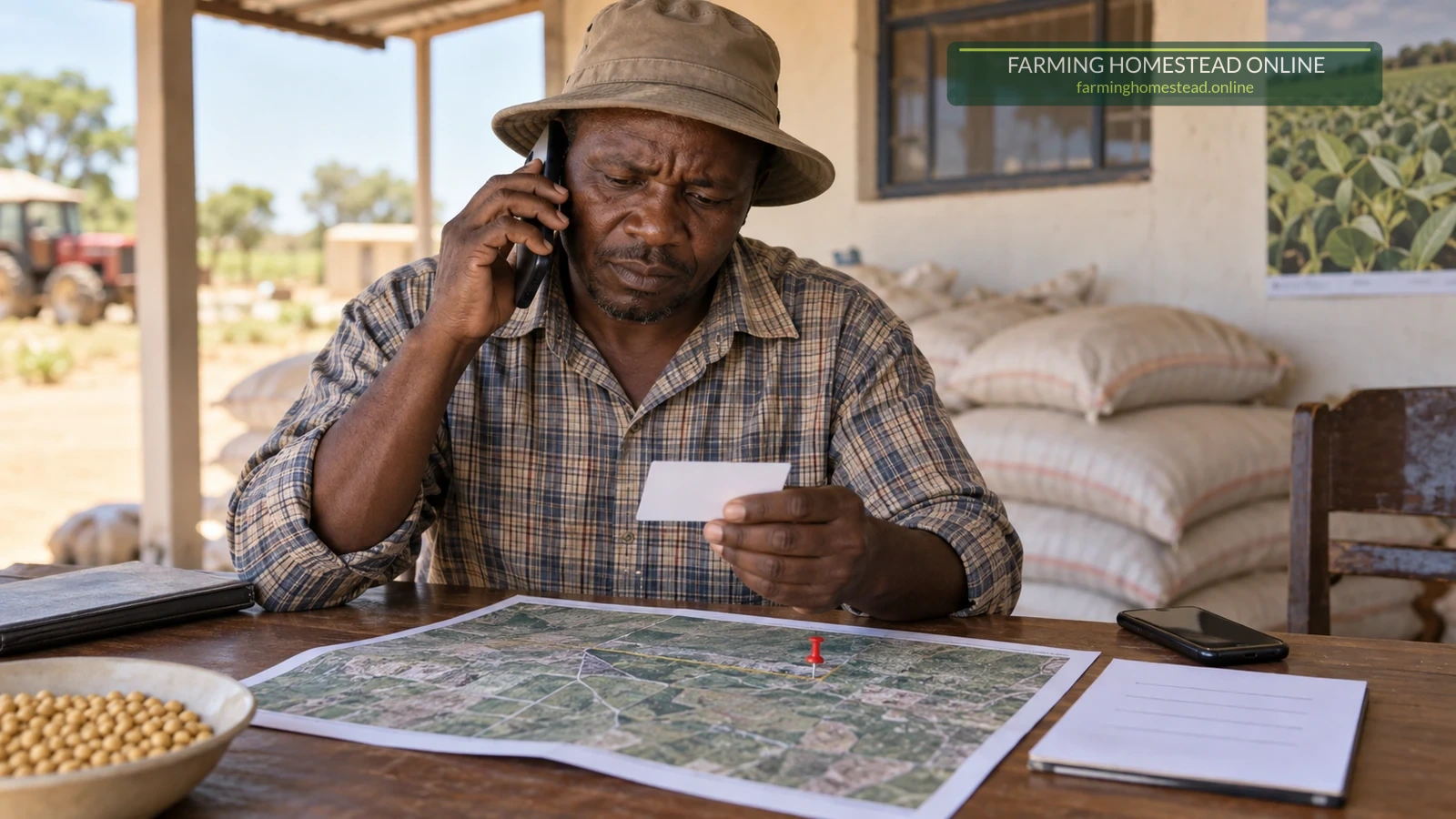
Do not use only the phone number in the post. Find the organisation’s official website, regulator listing, verified published number or physical office independently. Call that contact and ask whether the person, requirement and bank details are genuine.
A WhatsApp Business name can be typed by the account holder. A logo can be copied. A company certificate can be altered. Match several independent facts.
Step 2: Check the correct agricultural registration
The Agricultural Marketing Authority provides registration routes for grain and oilseed traders, brokers, contractors, warehouses and other agricultural businesses. The correct category depends on what the buyer is doing and the volume.
Ask AMA to confirm:
- whether the certificate is current;
- the legal name on the certificate;
- the activity and crop category;
- the registered premises;
- the permitted marketing season or validity period; and
- whether the claimed buying volume needs another category.
Do not accept a blank AMA form, an old certificate or a blurred photo as proof. The Authority’s certificate format includes the registered name, marketing season and physical premises. Confirm the actual certificate through an independent AMA contact.
If the buyer supplies a tax-clearance certificate, ZIMRA provides an online verification route using the taxpayer number and authentication code or QR code. Match the returned taxpayer name with the buyer and bank account. Tax clearance shows tax status. It does not replace AMA registration or prove the buyer can pay for your grain.

Step 3: Test whether the claimed volume makes physical sense
One thousand tonnes is a large movement for a smallholder conversation.
At 30 tonnes per truck, 1,000 tonnes is roughly 34 full loads. The number changes with the legal payload and actual vehicle. Ask:
- Is 1,000 tonnes the total programme, a monthly requirement or one delivery?
- Is the buyer purchasing directly or collecting leads for someone else?
- Which warehouse, processor or depot will receive it?
- What is the daily receiving capacity?
- How many trucks are booked?
- Who owns or hires the trucks?
- Where will the grain be stored?
- What scale will be used?
- Who pays transport, offloading and waiting time?
- What happens when the depot rejects or delays a load?
You do not have to supply the whole requirement. A buyer who wants 1,000 tonnes should still be able to issue a proper order for your one, two or ten tonnes.
Visit the premises before the main delivery. Confirm the address, business name, receiving area, scale, people, working hours and crop activity. Do not hand over originals of your identity, land or registration documents to gain entry.
Step 4: Demand a written purchase order or buying agreement
The document should state:
- buyer and seller legal names;
- crop and variety where relevant;
- quantity and allowable difference;
- bag, bulk or pack standard;
- grade, foreign matter, damage and pest limits;
- moisture limit and testing method;
- sampling method and retained sample;
- price per unit or exact price formula;
- taxes, levies and permitted deductions;
- collection or delivery point;
- who pays transport, loading, offloading and waiting;
- weighing method and dispute process;
- rejection process and who pays return transport;
- payment method and due date; and
- responsible signatories.
Do not load against “we will agree the price when you arrive”. Do not accept “market price” without identifying the market, date, grade and adjustment method.
If the buyer will pay after resale or processing, the seller is financing the buyer. Decide whether you can carry that credit risk.
Step 5: Agree how quality will be tested
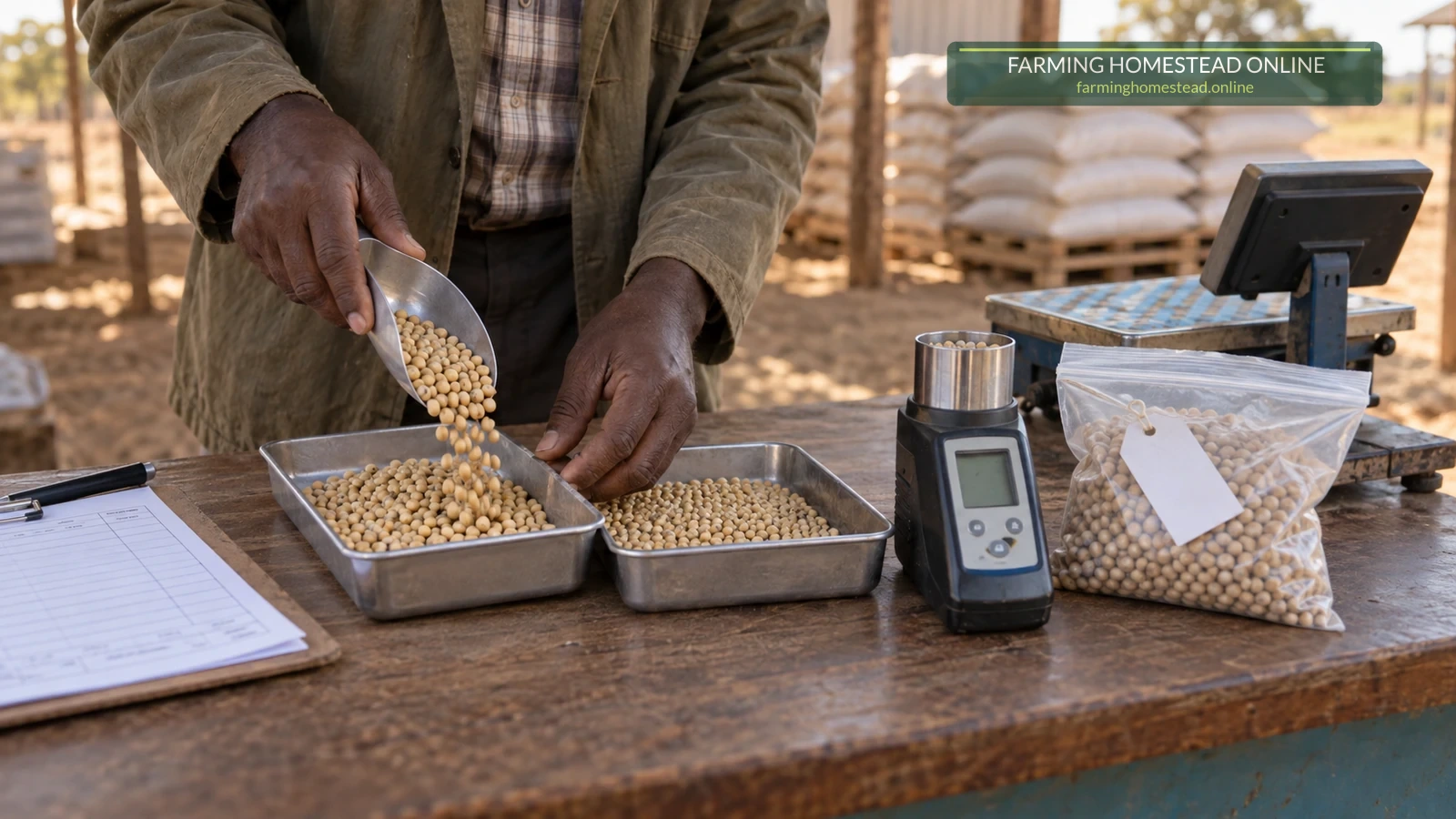
For soyabeans, moisture affects storage safety, weight and buyer acceptance. FAO guidance identifies about 13% as an important harvest and storage reference, while hot conditions, storage length and a buyer’s specification may require a different limit.
Before delivery:
- take small samples from different bags or parts of the lot;
- combine and split them using a consistent method;
- check moisture more than once with a tested meter;
- inspect odour, heating, insects, mould, splits and foreign matter;
- seal and label a retained sample;
- record your scale check and net mass; and
- send the buyer a representative pre-delivery sample if required.
Ask which test result controls the sale when your meter differs from the buyer’s. A vague answer becomes an expensive argument after the truck has travelled.
Our Three-Hectare Soyabean Farm with Moisture-Tested Aggregation and Bulk Dispatch Project Pack includes the field, intake, retained-sample, moisture, scale, lot, dispatch and payment records for a cautious first aggregation cycle.
Step 6: Verify bank and payment instructions
The bank-account name should match the verified legal buyer unless a documented relationship explains the difference.
Red flags include:
- payment to a personal account for “registration”;
- an advance “release”, “permit”, “fuel” or “warehouse” fee;
- a last-minute bank-account change sent only by WhatsApp;
- a screenshot instead of cleared funds;
- an overpayment followed by a refund request;
- a cheque or transfer that cannot be confirmed independently;
- pressure to hand over the crop before a delivery note is issued; or
- a promise that a third party will settle later.
If bank details change, call the buyer using the independently verified number. Do not reply to the same message and call that verification.
Step 7: Run a small paid trial

The strongest proof is not a testimonial. It is your own controlled small transaction.
Choose a trial quantity you can afford to have delayed. Keep the rest of the grain in safe storage. Before the trial truck leaves, hold the written order, buyer verification, crop record, bag count, moisture readings, retained sample, truck details and dispatch weight.
At the buyer:
- witness or appoint someone to witness weighing;
- record gross, tare and net weight;
- record grade, moisture and rejected quantity;
- require a signed delivery note;
- compare every deduction with the agreement;
- receive the final statement; and
- confirm cleared money in the correct account.
Only then decide whether to release a larger lot.
One paid tonne does not prove the buyer can pay for 100 tonnes. Increase exposure in measured steps.
A practical buyer scorecard
Do not score popularity. Score evidence.
| Check | Minimum evidence | Result |
|---|---|---|
| Legal identity | Registered name matches documents and bank | Pass / Stop |
| Agricultural authority | Current AMA category confirmed independently | Pass / Stop |
| Tax identity | Certificate validates and name matches | Pass / Check |
| Premises | Physical receiving site visited or independently confirmed | Pass / Stop |
| Authority to buy | Named officer confirmed by the organisation | Pass / Stop |
| Written order | Crop, quantity, grade, price, transport and payment stated | Pass / Stop |
| Quality method | Sampling, moisture, grade and dispute process agreed | Pass / Stop |
| Scale | Accepted scale and weight evidence defined | Pass / Stop |
| Payment | Bank and due date verified | Pass / Stop |
| Trial | Small delivery paid and reconciled | Pass / Limit exposure |
Any “Stop” means the main crop stays where it is.
If the delivery goes wrong
Protect people first. Do not start a confrontation at a depot.
Keep:
- the original post URL and screenshots with dates;
- profile or Page details;
- messages, calls and named contacts;
- certificate and tax-verification results;
- purchase order or agreement;
- grain photographs and retained samples;
- moisture and scale checks;
- truck, driver and route details;
- signed delivery note;
- buyer grade and weight result;
- deduction statement; and
- bank proof.
Write a same-day chronology while memories are fresh. Use the contract’s dispute process. Contact AMA for the regulated marketing issue. Contact the bank immediately for a payment fraud concern. Report the Facebook account or content through Meta’s reporting tools where appropriate. For theft, fraud, threats or forged documents, seek legal advice and report to the proper law-enforcement authority.
Do not publish accusations you cannot prove. Preserve evidence and use the official route.
Frequently asked questions
Is a Facebook Page safer than a personal profile?
Not automatically. A Page can provide history and contact detail, but those facts still need independent verification.
Are many comments and reactions proof of a buyer?
No. They show attention. They do not show registration, funds, receiving capacity or completed payment.
Is an AMA certificate enough?
It is an important check. You still need to confirm the certificate, activity, premises, crop terms, payment capacity and your written order.
Should I send a free sample?
A small representative quality sample may be reasonable when the buyer and destination are verified. Do not send a saleable load as a “sample”. Agree who pays courier or delivery costs.
Can an agent buy for another company?
An agent should provide written authority that the principal company confirms independently. The purchase order and payment responsibility must name the correct parties.
What if the buyer refuses a small trial?
Do not increase your risk to make the buyer comfortable. A genuine high-volume buyer should be able to explain a documented onboarding or trial process.
The decision
Facebook can help farmers find real buyers. It can also place a false buyer one phone call away from a valuable crop.
Use the platform for discovery. Move verification outside the post. Confirm the legal entity, registration, premises, person, order, quality method, scale, bank and payment. Test the chain with a small delivery.
The crop moves only after the evidence is stronger than the promise.
Next step: Copy the buyer scorecard into your farm record. Complete every line before you book transport or release a single bag.
Sources and useful checks
- Agricultural Marketing Authority application forms
- Agricultural Marketing Authority small-scale grain and oilseed trader requirements
- Agricultural Marketing Authority statutory instruments
- ZIMRA guidance on authenticating a tax-clearance certificate
- Meta Help Centre: how Marketplace ratings work
- FAO soybean harvest and storage moisture discussion
This Guide is general planning information. It is not a guarantee that a buyer is genuine, a legal opinion or a substitute for current regulator, bank and professional checks.
Join the farm conversation
Share what is working on your farm, ask a clear question or add a useful local experience.
Sign in to leave a reply
A free account keeps the discussion useful and places your name beside your reply.
Quickest option
After sign-up or sign-in, you will return to this article and this reply box.