

Prepared by the Farming Homestead Online editorial team. Sources and wording last checked on 2 September 2026. Use the guide for planning, then confirm current facts for your exact site.
Short answer: A high tomato price today can disappear before your harvest. High prices attract more planting. When many crops mature together, supply rises, buyers gain power and prices can fall quickly. Check your likely harvest week, speak to buyers, calculate your lowest acceptable price, stagger planting and plan how every grade will be sold before you buy seed.
The screenshots are exciting. A crate is selling for a strong price. A farmer posts a good harvest. Comments fill with one question: “How can I start?”
Within days, seed, chemicals, fertiliser and irrigation equipment are moving. New growers want to catch the money.
But the crop you plant today will not sell at today’s price. It will sell into the market that exists when your tomatoes are ready.
That difference can decide whether you make money or spend months working for nothing.
A detailed discussion in a Zimbabwe small-scale-farmer group made the problem clear. The writer explained that a shortage had pushed tomato prices up, but warned that the visible price would attract many farmers. Those new plantings could arrive together, create oversupply and force growers to compete for buyers. The comments agreed that the turn can be fast and timing is difficult.
This does not mean you should avoid tomatoes. It means you should plant with your eyes open.
The price you see is a message, not a promise
A market price tells you what happened at one place and one time. It may reflect a shortage, weather damage, disease pressure, transport problems, a gap between seasons or better quality in the market that day.
It does not promise the same price in eight, twelve or sixteen weeks.
The Agricultural Marketing Authority publishes commodity-price snapshots for named markets and dates. That is useful because it reminds farmers to compare where, when, grade and unit. A Mbare price on one date is not a permanent national price. A roadside price, retailer price, wholesale price and delivered contract price are also not the same thing.
Before you use any price in a budget, write next to it:
- the market;
- the date;
- the unit, such as kilogram, box or crate;
- the grade or size;
- whether transport is included;
- whether commission or market fees are deducted; and
- how quickly payment is made.
Without those details, the number can mislead you.
Why a high price can create the next low price
Tomatoes have a simple market problem. They are popular, many farmers understand the basic crop, and a successful-looking field is easy to copy. The harvested product is also perishable. Once ripe tomatoes are coming out of the field, the farmer cannot wait forever for a better price.
The cycle often looks like this:
- Supply becomes tight.
- Market prices rise.
- Farmers see the price and plant.
- Many crops reach harvest in the same period.
- Supply increases faster than demand.
- Buyers have more choice.
- Lower grades and late deliveries struggle first.
- Some farmers accept prices below their full cost to avoid losing the whole crop.
The smart farmer does not simply ask, “Are tomato prices high?”
The smart farmer asks, “How many other crops are likely to reach the same buyers when mine is ready?”
You will never have perfect information. You can still make a much better decision than copying a price post.
Seven questions to answer before you plant
1. Who will buy in your harvest week?
Name the customer type. Vendors? A fresh-produce market? Retail shops? Restaurants? Schools? Caterers? A processor? Households? A trader who collects at the farm?
Speak to real people in at least three routes. Ask about normal buying days, quantities, preferred varieties, firmness, colour, size, packaging and payment.
A person who says, “Bring tomatoes, I will find a market,” is a possible contact. A buyer who tells you the required grade, weekly quantity, delivery point and payment terms is much more useful.
Do not depend on one buyer unless there is a clear supply agreement and you understand the conditions.
2. What are other farmers likely to harvest then?
Talk to seedling suppliers, agro-dealers, extension workers, market traders and farmers in your area. Nobody will know every planting, but several conversations can show whether tomato activity is rising.
Look beyond your district. Tomatoes can travel into your market from other production areas. Imports can also affect supply. Your local field may be small, but your selling competition may not be local.
Ask what happened in the same period last year. Note disease-heavy months, heat, frost risk, heavy-rain periods and common market gaps. History will not repeat perfectly, but it can expose the weeks in which every farmer normally wants to sell.
3. What is your true floor price?
Your floor price is not the price you hope to receive. It is the minimum average price needed to cover the full saleable output cost and protect the next cycle.
Start with all costs:
- seed or seedlings;
- land preparation;
- manure and fertiliser;
- crop protection;
- water pumping and irrigation repair;
- labour, including family labour if the farm is meant to be a business;
- stakes, string and pruning materials where used;
- crates and packaging;
- harvesting and grading;
- transport, market fees and commissions;
- rejected, spoiled or unsold produce; and
- a repair and risk reserve.
Then divide the total by the kilograms you realistically expect to sell, not the maximum kilograms the plants might produce.
Simple example
Suppose a farmer’s complete crop and selling cost is US$3,600. The best-case projection says 8,000 kg, but the farmer expects only 6,000 kg to be saleable after lower grade, damage and loss.
US$3,600 divided by 6,000 kg gives a cost of US$0.60 per saleable kilogram before owner profit.
If the budget instead divides by the full 8,000 kg, it shows US$0.45 per kilogram and makes the crop look safer than it is.
This is an example, not a current market quotation. Use your own measured area, supplier prices, yield range and buyer terms.
4. Can you plant in smaller blocks?
One large planting creates one large harvest problem.
Staggering means planting separate blocks at planned intervals. It spreads harvest, labour, crates, transport and buyer demand. It also lets the farmer learn from the first block before spending on all later blocks.
Staggering does not remove market risk. If the low-price period lasts for months, several blocks may still be affected. It does reduce the chance that the entire crop must be sold in one crowded week.
Keep the intervals realistic for your variety, season and production system. Record the planting date, expected first harvest, peak weeks and end date for every block.
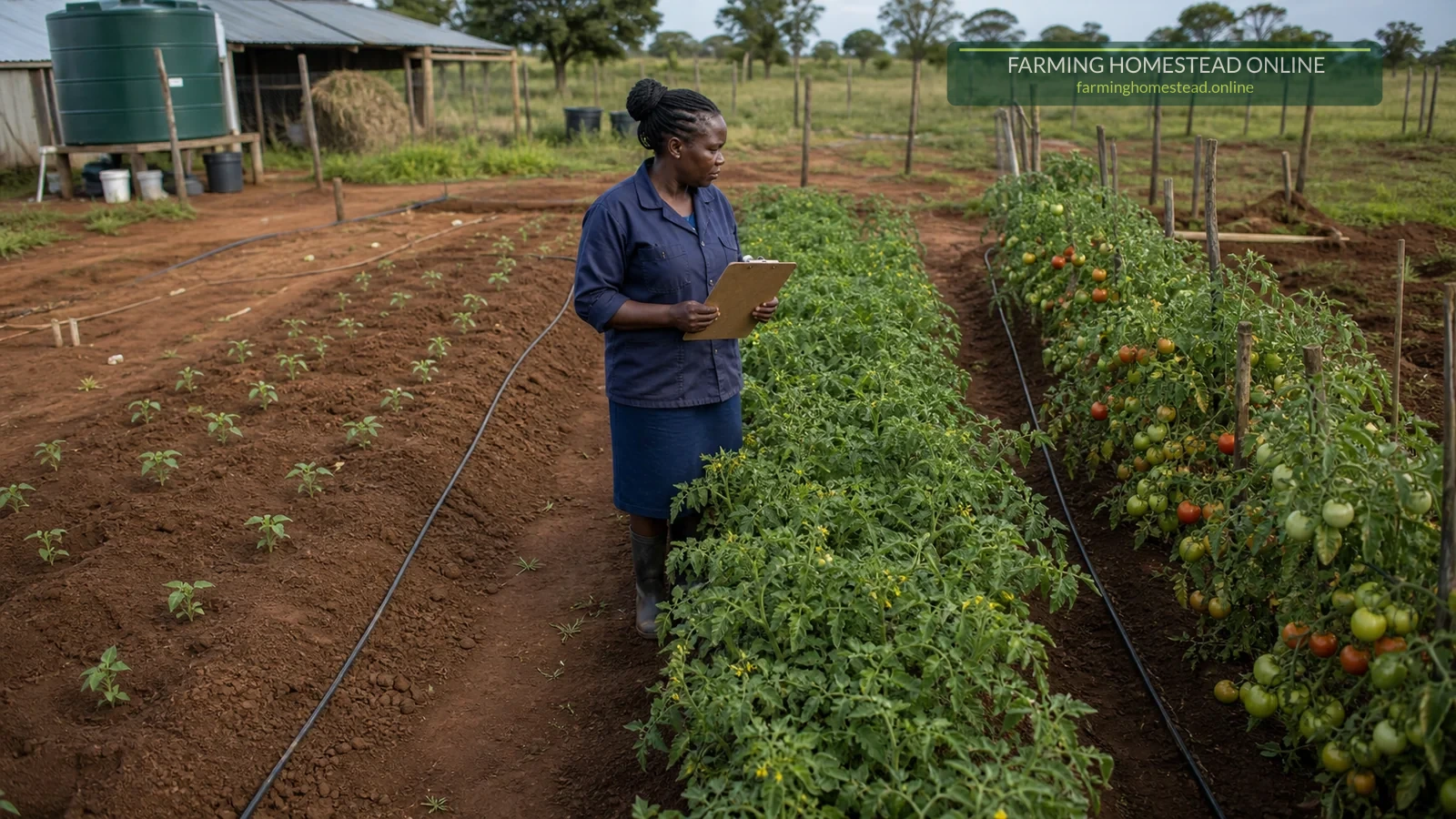
5. How will you sell each grade?
Not every tomato from the same field earns the same price.
Plan three routes:
- Top grade: firm, uniform produce for the most demanding buyers.
- Middle grade: sound produce for ordinary traders, caterers and local shops.
- Lower grade: usable produce that needs a quick route, smaller pack or processing buyer.
Do not wait until harvest to ask who can use the lower grade. It is already losing time.
Basic shade, clean reusable crates, careful picking, sorting and quick dispatch can protect value. Throwing mixed ripe, damaged and firm tomatoes into one container allows the worst fruit to reduce the price of the best.
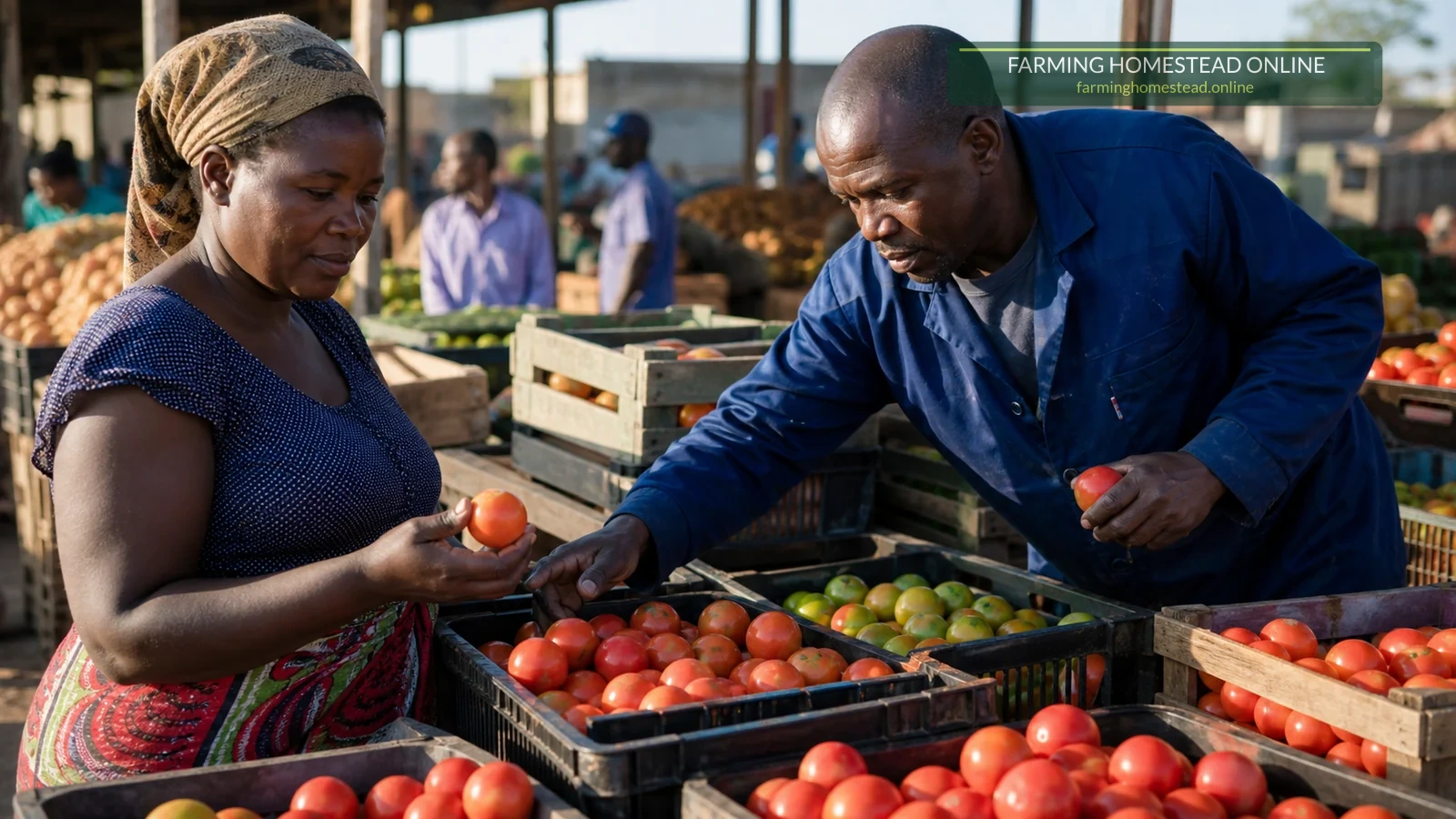
6. What is your harvest-day transport plan?
Transport is part of production.
Write down who will collect, the vehicle capacity, travel time, loading method, fuel or hire cost, backup vehicle and market opening time. Confirm whether the buyer pays on delivery or later.
A cheap transport quote that arrives six hours late can be more expensive than the reliable option. Heat, stacking damage and missed buying windows reduce saleable quality.
If you plan to deliver several small orders, map the route. A strong selling price can disappear inside repeated short trips.
7. What will you do if the price falls?
Do not answer, “I will wait.” Ripe tomatoes may not give you that choice.
Decide before planting:
- the lowest average price you can accept;
- which buyer route receives the best grade;
- whether lower grades have a processor or food-service route;
- whether production can be reduced before later blocks are planted;
- what spending can be paused without damaging the current crop; and
- how much cash reserve protects harvest and delivery.
The aim is not to predict the exact future. It is to know your moves before pressure arrives.
Protected growing helps production—but it does not create a buyer
A well-designed greenhouse or protected-crop structure can improve control over rain, irrigation, plant support and crop care. It may help a skilled grower target periods when open-field supply is more difficult.
It does not cancel market risk.
Protected production adds its own costs: the structure, plastic or covering, irrigation, trellising, ventilation, repairs, crop hygiene and skilled daily management. A greenhouse full of tomatoes without customers is still a marketing problem.
The Nyazura One-Hectare Greenhouse Farm Project Pack connects protected tomatoes and peppers with water, handling, onions, broilers, sheep and phased development. The value is the connected system, not a promise that one structure guarantees profit.
For a smaller protected-cropping start in a drier area, compare the Gwanda Half-Hectare Timber Greenhouse and Leafy-Side-Garden Project Pack.
Your market plan should fit on one page
Before planting, complete this simple sheet:
| Decision | Your answer |
|---|---|
| Planned area and number of plants | |
| Variety and reason for choosing it | |
| Planting date by block | |
| Expected first and peak harvest by block | |
| Buyer 1: quantity, grade, place and payment | |
| Buyer 2: quantity, grade, place and payment | |
| Buyer 3 or backup route | |
| Total complete cost | |
| Realistic saleable kilograms | |
| Cost per saleable kilogram | |
| Target average selling price | |
| Lowest acceptable average price | |
| Harvest crates and labour | |
| Main and backup transport |
If the empty spaces are large, do more calls before buying inputs.
Facebook is useful—but a post is not the whole market
Facebook groups can help you see supply, contact traders, compare asking prices and find buyers. Use them well.
A useful selling post answers the buyer’s immediate questions:
- What product and variety is available?
- What grade and pack size?
- What quantity is ready now?
- Where is it?
- What is the collection or delivery arrangement?
- What is the price unit?
- How can the buyer contact you?
Post clear photographs of the actual produce. Reply quickly. Move serious customers into a direct order record.
At the same time, remember what the research feed showed: a farmer’s post competes with dozens of other farm adverts and even unrelated products. Build direct buyer relationships outside the group. Keep phone numbers, buying patterns and payment history.
The better question is not “Are tomatoes profitable?”
Tomatoes can produce strong returns for a farmer who controls the crop, timing, grade, costs and market. The same crop can lose money when the budget assumes a perfect yield and today’s best price.
Ask this instead:
Can my planned crop make money at the realistic harvest price, after losses, grading, transport and delayed payment?
If the answer is yes, plant with a plan. If the answer is no, reduce the area, change the timing, find a stronger buyer or choose another enterprise. A decision not to copy the crowd can save enough money to fund the right project later.
Turn the crop idea into a complete farm plan
A Farming Homestead Project Pack helps you connect the market decision to the physical farm: layout, water, production units, buying list, sequence, timing, handling, risks and minimum workable start.
Read the free previews, compare the options and buy the full Pack you need for US$10 through the current WhatsApp process.
Browse all crop and mixed-farm Project Packs.
Frequently asked questions
What month gives the highest tomato price?
There is no month that guarantees the highest price every year. Weather, disease, local plantings, supply from other areas, imports and buyer demand can move the market. Use recent dated market information, speak to buyers and study your target harvest window.
Should I plant when tomato prices are high?
Only if your expected harvest market, complete cost and buyer plan still make sense. Today’s price may signal a shortage, but it can also trigger the new plantings that create tomorrow’s oversupply.
How many buyers should I have?
Have at least three realistic routes: a main buyer, a second route and an outlet for lower grades or sudden surplus. The exact number depends on your volume, but one unconfirmed middleman is not a market plan.
Is greenhouse tomato farming safer than open-field production?
It changes the risks. A greenhouse can improve environmental and crop control, but it costs more and needs good ventilation, water, hygiene and management. The crop still needs a buyer and a price that covers the structure and operating cost.
How do I calculate tomato profit?
Add every growing and selling cost. Estimate realistic saleable kilograms after loss and lower grade. Multiply saleable quantities by realistic prices for each grade. Subtract the full cost. Also check when the money is paid, because profit on paper cannot buy tomorrow’s inputs if the buyer pays late.
Join the farm conversation
Share what is working on your farm, ask a clear question or add a useful local experience.
Sign in to leave a reply
A free account keeps the discussion useful and places your name beside your reply.
Quickest option
After sign-up or sign-in, you will return to this article and this reply box.